4Photos in national parks
Taking commercial photos in national parks
In NSW national parks, personal photos need no approval but commercial photography does; Parks Victoria says a permit is typically needed for photography on land it manages that is conducted as a trade or business, and it names commercial and portrait photographers. In Kakadu and Uluru-Kata Tjuta, Parks Australia requires commercial still photographers to hold a permit.
This is general information, not advice on any shoot or application. Each park authority’s own page is the official place to check, and every rule below is that authority’s alone. The pages are listed at the foot of this page.
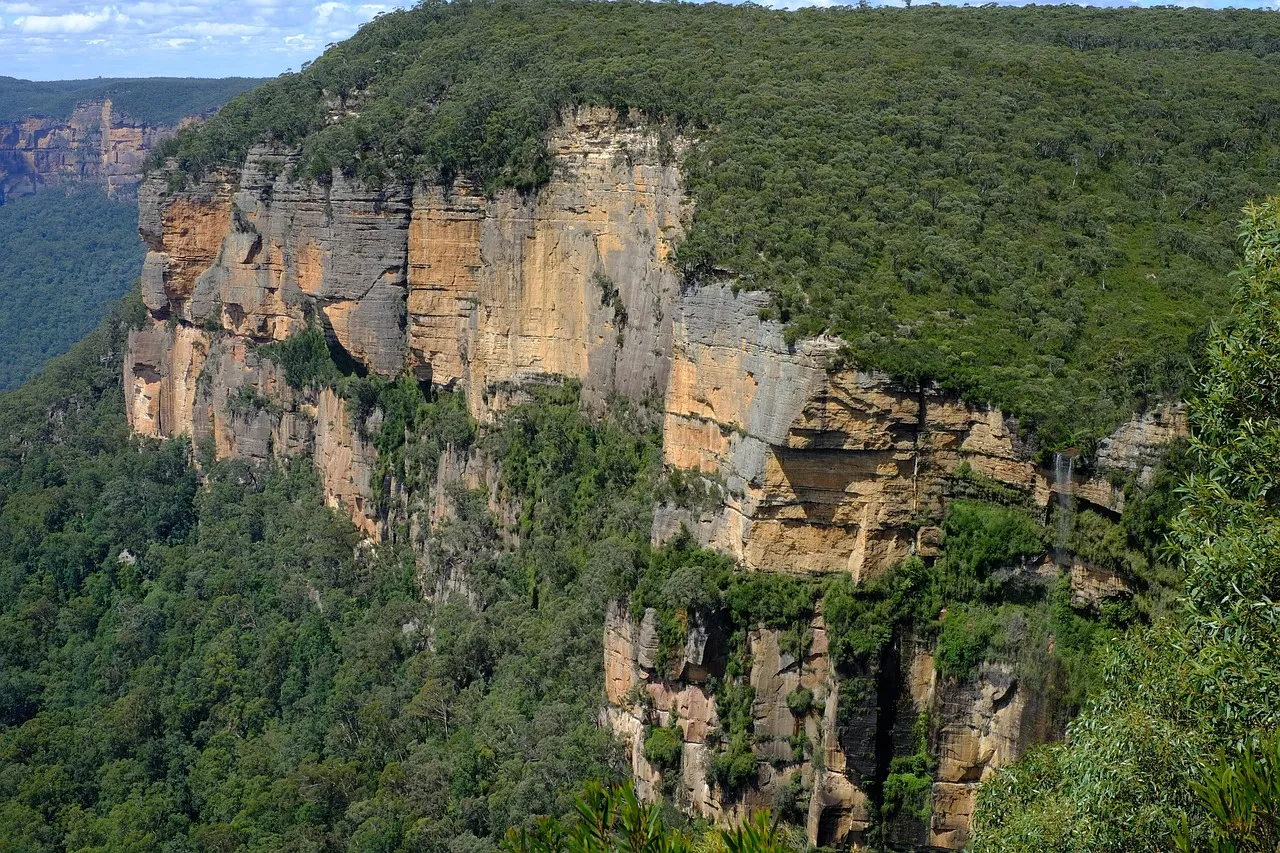 Frame 4 · Sandstone cliffs, Blue Mountains, New South Wales
New South Wales · National Parks and Wildlife ServicePersonal use is free; commercial work needs approval
“You don’t need approval to take photos or videos in NSW national parks for personal use. You do need approval for commercial filming or photography, student films and content created for business, promotional, sponsored or monetised purposes.” The service lists, as commercial purposes, “filming or photography for sale, advertising or promotion or other business purposes” and “sponsored or monetised content made by influencers, vloggers and other content creators.”
The smallest shoot costs nothing to apply for:
| Size of shoot | What the schedule describes | Application fee |
|---|---|---|
| Small scale | 1 crew, 1 assistant, 0–1 vehicle, 1 handheld or tripod camera with sound recorder, no unit base, no drone use | $0 |
| Low impact | 3–25 crew and talent, fewer than 4 vehicles, no construction or infrastructure, minimal equipment or lighting | $350, plus a $166 drone application fee where a drone is used |
Fees are charged for each park when more than one is selected, they are GST-inclusive, and they rise with the Consumer Price Index at the start of each financial year. NPWS’s policy and fee schedule add a few rules that shape a shoot:
- “NPWS does not own the copyright over any natural, historic or landscape features within parks.”
- “Prior written consent is required for the publication or use of any NPWS logo, uniforms, insignia, or the filming or photography of NPWS staff.”
- Where locations or material are culturally sensitive for Aboriginal people, the applicant must consult the relevant Aboriginal custodians and seek their endorsement before filming begins.
- For a park under an Aboriginal joint management agreement, its board of management also approves applications, and the schedule says to allow up to 12 weeks.
Victoria · Parks VictoriaA permit for trade or business, named for portrait work
Parks Victoria spells out who that means: “This includes, but is not limited to, advertising, promotions, feature films and television programming, commercial and portrait photographers, and some student productions.” By contrast, “A permit is generally not needed for amateur or hobby photographers with basic equipment, who are not making images commercially available”, and the page suggests applying if the images might be used commercially in the future. Wedding photography has its own permit process on a separate Parks Victoria page.
Lead time. At least 10 business days once all documents are received, or at least 20 business days with a drone; applications that do not allow these lead times will not be accepted.
Papers. A public liability insurance certificate of currency and a sitemap, with “a minimum of $20m public liability insurance coverage”, as Parks Victoria’s page stood on 8 October 2026.
Several dates. A permit can run for up to six months across multiple dates and parks, with the dates and parks specified.
No guarantee. “Completion and submission of a filming and photography permit application does not guarantee approval.”
“Recreational drones are not permitted at all on Parks Victoria managed land.”
Commonwealth · Parks AustraliaKakadu and Uluru-Kata Tjuta
Both parks’ media pages say all commercial film crews, still photographers, artists and sound recorders need a permit, and that “A commercial permit is also required to use an existing image of the park for a commercial purpose.” At Uluru-Kata Tjuta the page adds: “Please be aware that Uluru has great spiritual significance to traditional owners and some sites should not be filmed or photographed.”
In Kakadu, larger projects need a licence rather than a permit: those with crews of generally four or more, props or sets, access to areas not usually open to the public, or more than five days in the park. Kakadu’s page also says: “Permits issued by the Northern Territory Parks and Wildlife Commission for other NT Parks are not valid in Kakadu.”
City parks and streets · two councilsMelbourne and Sydney
Council land is not a national park, and two capital-city councils set their own terms. The City of Melbourne says filming or a photo shoot in its public places may need a permit. Its list of conditions that need one covers more than six people, counting all crew and talent, equipment beyond one camera, one tripod and handheld sound recording gear, using the Fitzroy Gardens Conservatory, blocking a footpath or road so that less than 2.5 metres is left for pedestrians at any time, pedestrian or traffic management, disrupting traders, residents, businesses, motorists or “other activations in the vicinity”, vehicle access to a location, and filming with a drone. The City calls a shoot with none of those conditions low impact, and says it then needs no notice to the City and no permit from it, as the page stood on 8 October 2026. The same page adds that some public places limit when filming can happen, a privately managed location may need its owner’s permission, and other permits and approvals may still be needed, depending on the filming. Wedding photos in the city’s parks and gardens cost nothing to take, unless the shoot needs a reserved space, but the Fitzroy Gardens Conservatory must be booked and needs a permit.
The City of Sydney asks for approval to film or photograph on its public land for anything beyond purely private, individual, non-commercial use, though a shoot entirely on private property, with no use of the City’s public land and no parking permits, needs no consent from the City. It says stills shoots should have $10 million in public liability cover, as the City’s page stood on 8 October 2026.
CASA says its drone safety rules “apply everywhere in Australia”, so they come to every one of these places, as drones for commercial photos explains, and a commissioned wedding shoot raises the ownership question in who owns a commissioned photo.